Technology
Flow chemistry moves a reaction through a controlled reactor system rather than holding the entire reaction mass in one batch vessel.
A flow reactor can improve control of mixing, heat transfer, residence time, pressure and dosing. It can also reduce the quantity of hazardous material held in the reactor at one time.
Read the detailHide the detail
Caxyo develops flow processes for chemistry that benefits from precise control, rapid heat removal, intensified mass transfer, safer handling or improved scale-up behavior. The first question is still whether flow is the right tool.
01
Feeds
Liquids, and a gas feed only when the chemistry requires it.
02
Metering
Dosing that sets stoichiometry and the rate of heat release.
03
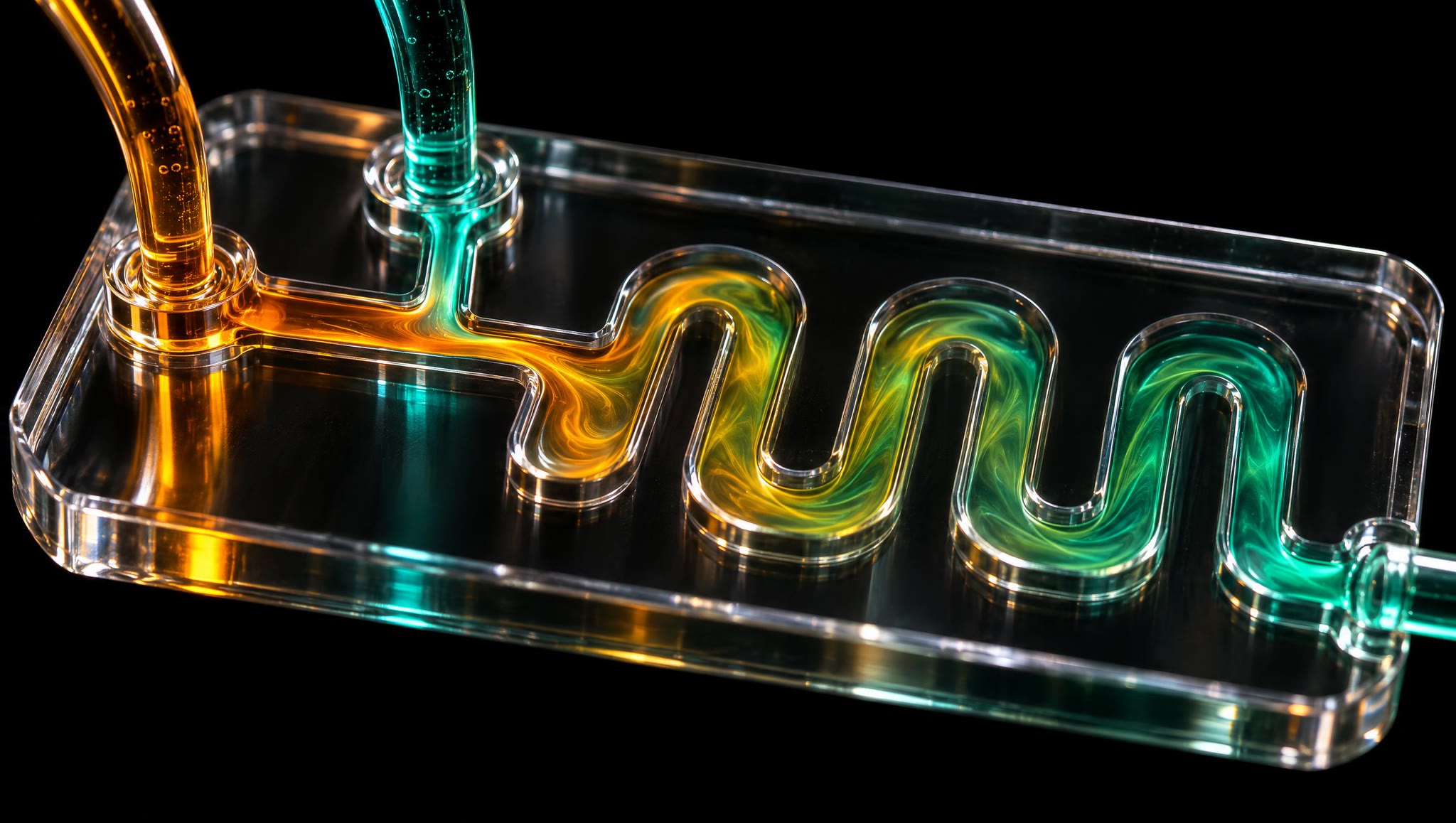
Mixing
The contact pattern the kinetics actually need.
04
Reactor
Residence time, temperature and pressure held together.
τ · T · P
05
Back-pressure
A defined outlet boundary, not an afterthought.
06
Quench
Stop the reaction before an unstable species has time to wander.
07
Collection
A receiving step that matches the work-up, batch or continuous.
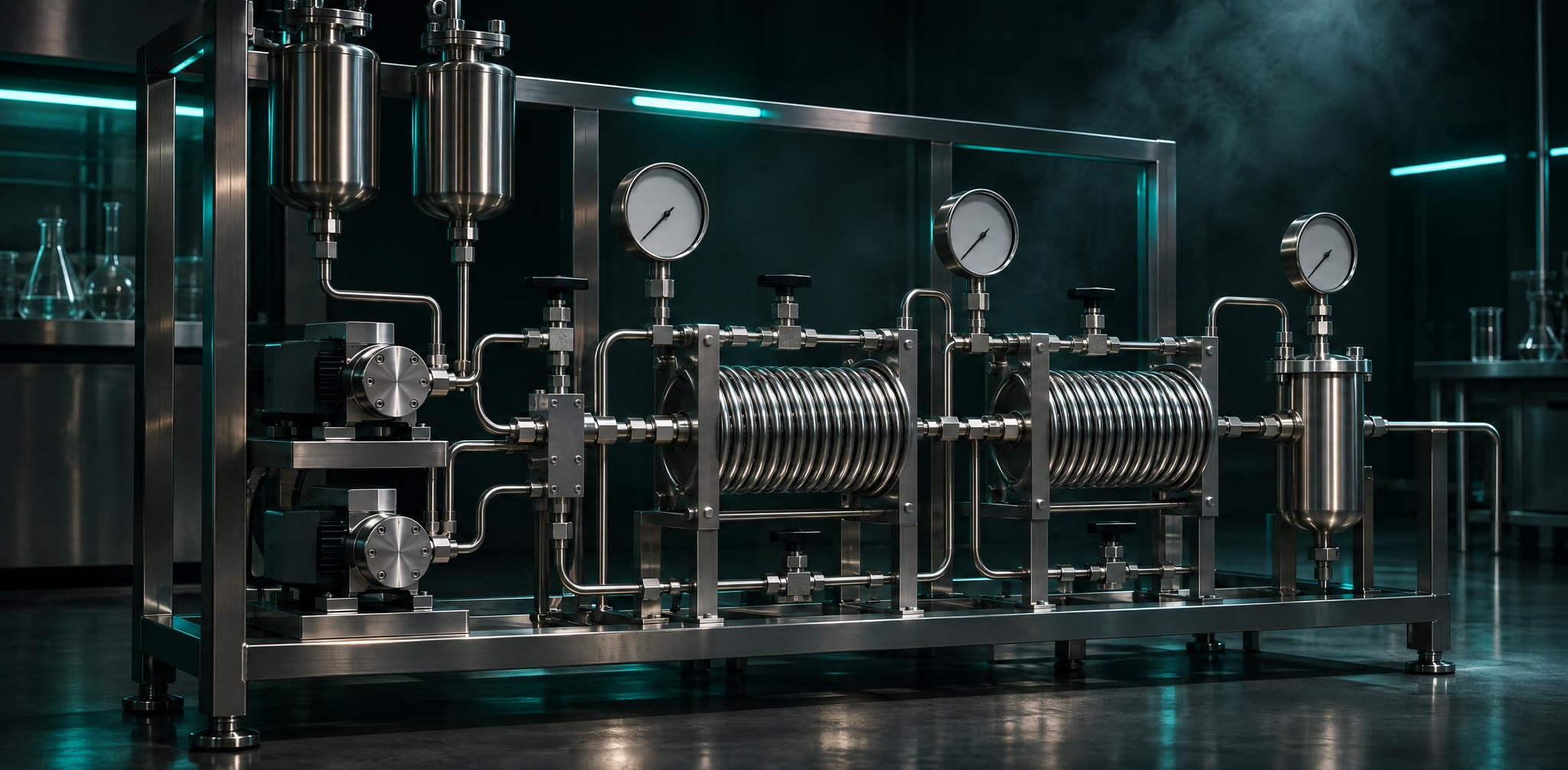
Generic system concept. Gas handling, photochemical modules, solids strategy and safety interlocks are added only when the chemistry requires them. This is not an installed Caxyo system and it has no rated capacity.
Data and automation
A controlled system, not a larger batch vessel.
For the steps where heat, mixing, residence time or a hazardous inventory is the limit, a flow system with the right automation holds the chemistry more tightly than a stirred tank. Batch remains the right choice when it is already robust.
Process data, taken on the run
Flow rate, temperature, pressure and residence time are recorded as the reaction moves. A pharmaceutical team can see drift and the impurity response without reconstructing the batch from a logbook.
Automation fitted to that chemistry
Dosing, heating and cooling, back-pressure, quench and shutdown are tied to those measurements. The automation is specified for the hazards and the quality system of the project. It is not a generic plant claimed in advance.
Models used on the data
Statistical and AI models read that dataset to find the operating window: which parameter moves yield, which one only adds noise, and where the process is about to leave specification. The chemist still owns the decision.
Where this beats batch
Less material is held at reaction conditions. Heat leaves through the wall instead of through a slow addition. The same residence time can be kept while throughput rises. Operator-dependent charging is replaced by a metered feed.
What Caxyo can support
Scope is agreed per project. Instrument ownership, automation level and GMP status are not implied by this list.
- 01Reaction and equipment suitability assessment
- 02Laboratory flow screening
- 03Reactor and material selection
- 04Residence-time and flow-rate studies
- 05Mixing and heat-transfer evaluation
- 06Pressure-control strategy
- 07Gas and liquid feed design
- 08Photochemical reactor concepts
- 09High-temperature and low-temperature process concepts
- 10Process analytical technology strategy
- 11Continuous and semi-continuous work-up concepts
- 12Process robustness and operating-window development
- 13Scale-up and technology-transfer packages
Sequence
Flow chemistry development, in order.
- 01
Chemistry and hazard review
The transformation, reagents, thermal behavior and known failure modes are reviewed before a reactor is chosen.
- 02
Batch-process baseline and problem definition
Current conditions, additions, hold times, impurities and the real scale-up constraint are written down.
- 03
Flow feasibility and reactor selection
Residence time, mixing, heat transfer and materials are matched to a reactor concept, or the step stays in batch.
- 04
Parameter screening
Flow rate, concentration, temperature, pressure and quench behavior are explored at laboratory scale.
- 05
Design-space and operating-window development
The parameters that control yield, selectivity, impurities and safety are mapped.
- 06
Continuous-run demonstration
A sustained run checks stability, fouling, control and analytical sampling. The scope depends on the chemistry.
- 07
Work-up, isolation and analytical package
Downstream handling is developed with the reaction, not treated as a separate afterthought.
- 08
Scale-up and transfer recommendation
The package states what should change with throughput, and what must stay constant.

Next step
Request a flow feasibility review.
Share the transformation, the current batch behavior and the constraint you want under control.